

Growth is often seen as a positive challenge, yet it can quickly become a source of friction when internal processes, such as travel management, struggle to keep pace.
In the early stages of a business, a scrappy approach is often sufficient: teams rely on shared spreadsheets, a handful of loyalty programs, and individual employees booking their own travel while submitting expenses afterwards.
This method offers a level of speed and flexibility that works well when travel volume is low and oversight is manageable.
However, this approach has clear limits. As the business expands, so does the complexity of managing travel. An increase in travelers leads to a higher volume of bookings, more frequent changes, and greater costs to monitor – each introducing additional opportunities for errors and inefficiencies. What once felt agile and efficient can quickly become fragmented and difficult to control.
This is the point at which growing businesses must move beyond improvised systems and adopt a more scalable, structured approach to travel management, one that platforms like KAYAK for Business are built to support.
If your current process is starting to show signs of strain, it may be time to take a more structured approach.
Book a demo here.
The moment scrappy stops working
The early signs that a travel process is no longer fit for purpose often appear through everyday inefficiencies, long before they are formally measured or reported.
Employees may book outside of policy simply because expectations are unclear, finance teams spend valuable time chasing missing receipts at the end of each month, and last-minute bookings become unnecessarily expensive due to a lack of visibility into available options.
At the same time, travelers lose time navigating multiple platforms instead of focusing on their work. While each of these issues may seem minor in isolation, together they create friction across the business and reduce overall efficiency.
Over time, it becomes clear that spreadsheets and email threads are no longer sufficient to support a growing organization, as they were never designed to scale with increasing travel volume, larger teams, or the need for real-time visibility.
This is the point at which the limitations of a scrappy approach become undeniable.
Why travel processes need to scale earlier in the growth journey
Many SMBs delay upgrading their travel processes, often viewing it as something to address later when the company is larger; however, travel is typically one of the first operational areas to be tested during periods of growth, as expansion into new markets, increasing headcount, and a rise in client meetings quickly drive a significant increase in travel demand.
Without structure, it creates risk:
- Costs become unpredictable
- Policies are unclear or ignored
- Time is lost on manual coordination
- Teams operate without shared visibility
And most importantly, it impacts confidence: leaders don’t have a clear view of spending, employees aren’t sure what they can or should book and finance lacks control without adding friction.
Scaling your travel process isn’t about adding complexity, it’s about removing uncertainty.
What scalable travel actually looks like
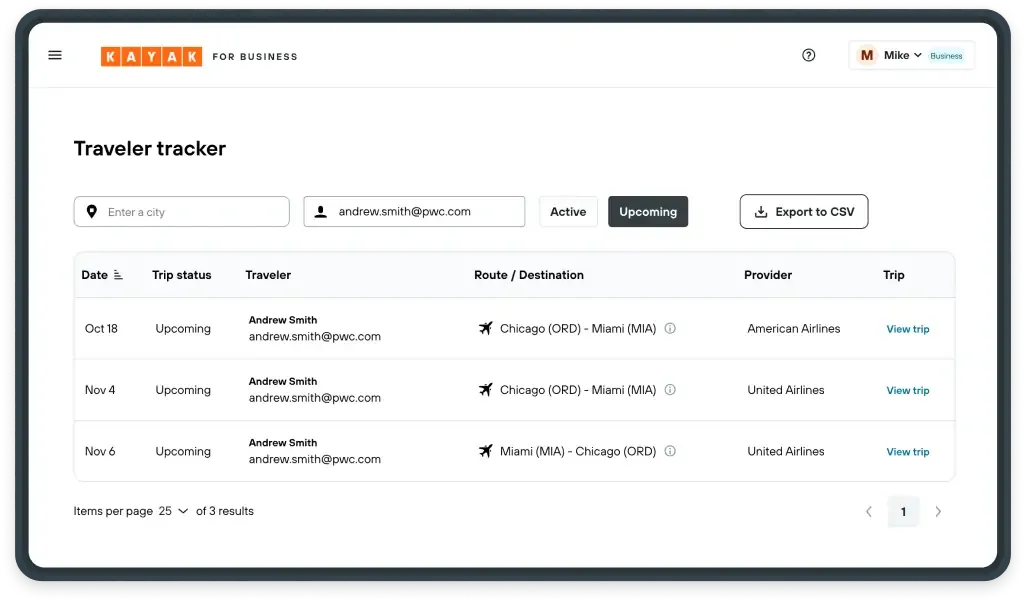
A scalable travel process gives teams a clear, simple way to book travel that aligns with company needs, without extra steps, emails, or approvals.
It means:
- All travel options in one place
- Policies that guide choices without blocking them
- Real-time visibility into spend and bookings
- Centralized data without chasing it
This is where tools like KAYAK for Business come in. Instead of layering complexity onto a broken system, it replaces it with something built for how modern teams actually work.
No spreadsheets. No guesswork. Just a better way to manage travel.
From reactive to proactive
Scrappy travel management tends to be reactive, with teams addressing issues only as they arise, whereas a scalable system introduces a more proactive and structured approach.
Policies are clearly defined from the outset, budgets are visible before any bookings are made, and travelers understand their options without relying on lengthy approval chains, while finance teams benefit from having immediate access to centralized data rather than needing to chase it.
This shift enables growing teams to maintain control while continuing to move quickly and efficiently.
It also aligns with where travel management is heading. As outlined in The Future of Travel Management, businesses are moving away from rigid, outdated systems toward flexible platforms that adapt in real time. The goal isn’t more control, but smarter control.
Supporting teams without adding friction

One of the most common concerns among SMBs is that introducing a formal travel system will add complexity for employees; in reality, it should have the opposite effect by making the experience as simple and intuitive as booking personal travel.
That’s the standard, and it’s exactly what KAYAK for Business is built for.
Employees get:
- A familiar, intuitive booking experience
- Clear guidance on what fits company policy
- Freedom to choose within those boundaries
Managers get:
- Visibility without micromanaging
- Confidence that bookings align with company goals
Finance gets:
- Clean, centralized data
- Fewer surprises at month-end
Everyone wins because the system works with them, not against them.
Built for agility, not legacy
Traditional travel management systems were designed for a different era, relying on heavy processes, rigid approval structures, and limited flexibility, an approach that no longer meets the needs of modern SMBs.
Today’s teams require systems that operate at their pace, supporting fast-moving environments without adding friction, which is why agile travel platforms are increasingly replacing legacy tools, as explored in Agile Corporate Travel Systems .
This shift reflects a broader change in how travel is managed: moving away from control through restriction toward control through visibility and thoughtful design. The result is not just better management of travel, but a system that actively enables it.
Confidence to scale without chaos
Growth should feel like momentum, not something held back by operational friction.
As outlined throughout, a scalable travel process gives businesses the structure they need to grow with confidence, keeping travel organized and controlled as teams expand and demand increases. It does not require a complete overhaul overnight, but it does require recognizing when scrappy approaches are no longer sustainable and making a deliberate shift toward a more reliable system.
This is exactly where KAYAK for Business fits in, replacing manual, fragmented processes with a solution that is simple, clear, and built to scale alongside your business.
If your current approach is starting to show its limits, the next step is straightforward: adopt a system designed to support growth before inefficiencies compound. Explore a scalable approach with KAYAK for Business and see how it can support your team at every stage.
Book a demo here.
About KAYAK for Business
KAYAK for Business combines the power of the world’s leading travel search engine with tools designed specifically for business travelers. It serves companies of every size, from fast-growing startups to global enterprises, helping them book, manage, and track business travel in one place.
For more information, visit https://www.kayak.com/business/.