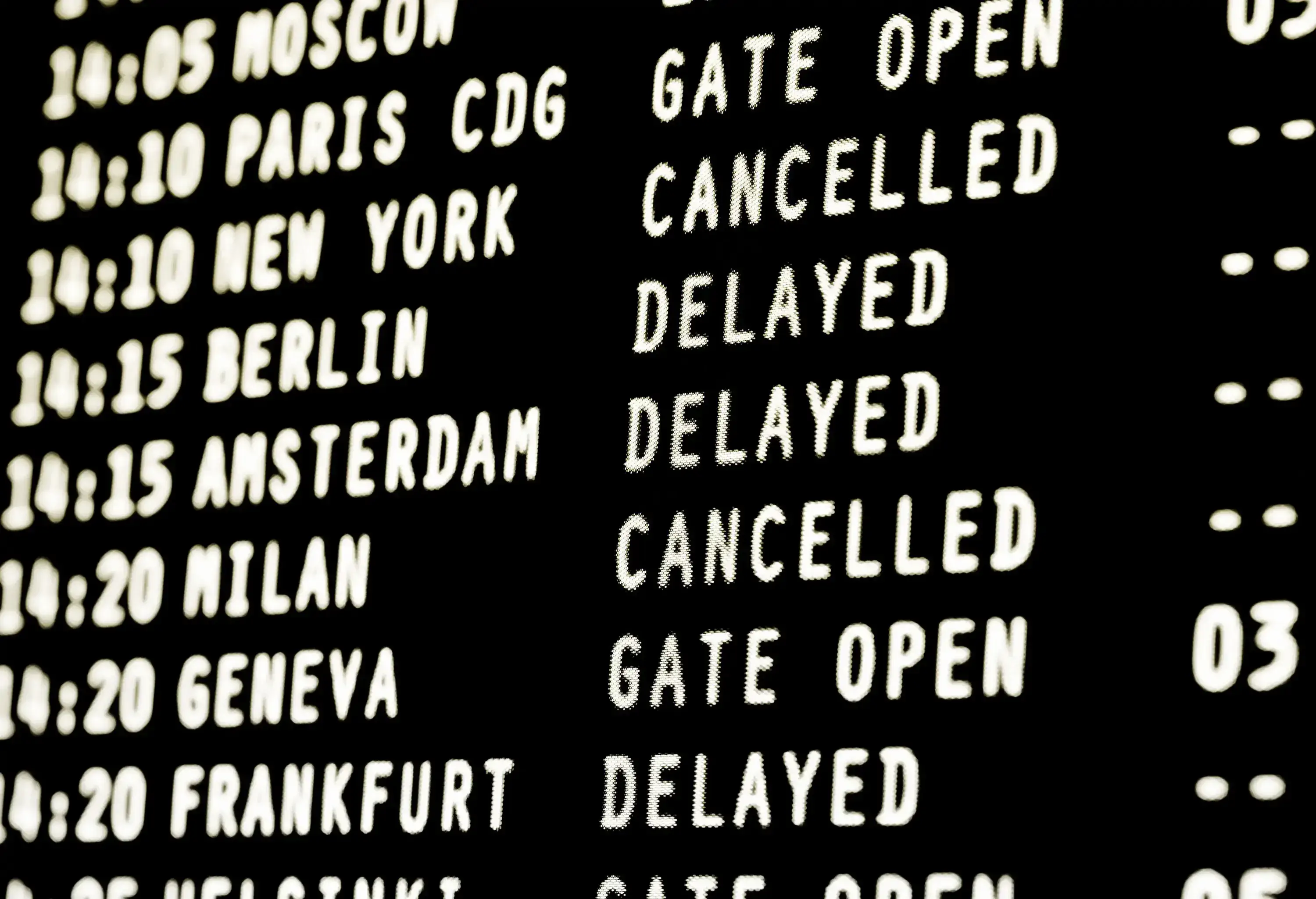

Airspace closures in the Middle East are continuing to impact flights. To help you plan ahead, we’ve answered the most common questions around the force majeure clause, flight cancellations and compensation. Along with some advice on what to do if your flight is impacted.
TL;DR: You are entitled to a refund or alternative transport option, and it’s always best to contact your airline directly.
Airlines and airports impacted by Middle East airspace closures.
Temporary airspace closures in Israel, UAE, Qatar, Iraq and Bahrain have disrupted major travel hubs, including Dubai and Doha.
Travel plans may be disrupted – always check local travel advisories before booking flights.
Airports impacted
Flights from the following airports are likely to be delayed, cancelled or disrupted. If you have already booked a flight, click the relevant link to view its current status.
- Dubai Intl Airport (DXB) – check your flight status
- Doha Hamad Intl Airport (DOH) – check your flight status
- Muscat Seeb Airport (MCT) – check your flight status
- Manama Bahrain Intl Airport (BAH) – check your flight status
- Amman Queen Alia Intl Airport (AMM) – check your flight status
- Kuwait City Airport (KWI) – check your flight status
- Riyadh King Khaled Intl Airport (RUH) – check your flight status
- Jeddah King Abdulaziz Intl Airport (JED) – check your flight status
- Medina Mohammad Abdulaziz Airport (MED) – check your flight status
- Dammam King Fahad Intl Airport (DMM) – check your flight status
Airlines impacted
Alongside any international airlines that route through the Middle East to Asia (Lufthansa and British Airways, for example), the following airlines are likely impacted.
Contact your airline if you need to change an upcoming flight.
- Emirates
- Etihad Airways
- Qatar Airways
- Air Arabia
- Gulf Air
- Oman Air
What happens if my flight is canceled due to rising fuel costs?
Airlines in the US, EU and globally are facing rising fuel costs since the start of the war in Iran this February. As a result, some airlines are increasing the cost of airfare or canceling flights. If your flight is canceled due to rising fuel costs or other reasons related to the war, you are entitled to a full refund.
Tip: If you are concerned about flight cancellations, book with an established airline with a large fleet.
What is a force majeure clause?
Force majeure literally means “superior force”. In travel, force majeure is a contract clause that excuses parties (travelers or providers) from fulfilling their obligations due to unforeseeable, unavoidable and external events beyond their control, such as natural disasters, war or pandemics.
It allows for cancellation or suspension of travel services without liability or compensation. Force majeure is sometimes referred to as acts of God.
What does this mean if I have a trip booked in an affected area?
When force majeure is declared, airlines and other companies like cruise lines can change itineraries, schedules and routes quickly and without penalty. For example, to avoid a route where a natural disaster or event may impact safety. If you decline the alternative option, you’re likely eligible for a refund.
A well-documented example of this was the closure of EU airspace following the eruption of the Eyjafjallajökull volcano in Iceland in 2010. During this time, many people decided to take alternative modes of transport, including trains, buses and taxis to get to their destination. Airlines also paid out millions in refunds.
Other examples of force majeure.
Some examples beyond reasonable control include:
- War (whether declared or not) or threat of war
- Strikes or other industrial action.
- Extreme weather, including storms, floods or earthquakes
- Subsidence (the sinking of an area of land)
- A fire or explosion
- An epidemic, pandemic or other natural disasters
- Impossibility of the use of railways, shipping, aircraft, motor transport or other means of public or private transport.
- Interruption or failure of utility service (including the inability to use public or private telecommunications networks)
- The acts, decrees, legislation, regulations or restrictions of any government
What am I entitled to if my flight is canceled?
Depending on where you are flying from, airlines generally must offer alternative modes of transport in the case of Force Majeure, such as airspace closures. If you decline the alternative, you are entitled to a refund (but not compensation).
In the US, under U.S. Department of Transportation (DOT) rules, passengers are entitled to cash refunds if an airline cancels or significantly changes a flight (including during force majeure events) and the passenger declines an alternative offered by the airline.
In the EU and UAE, similar rules apply, plus airlines must provide meals, accommodation and communication during long disruptions. This is not a legal requirement in the US.
If you do get a refund, it may take a little longer than normal to complete due to the sheer number of travelers that may be impacted.
Overview of your entitlements in the case of airspace closures or other force majeure events.
| Region | Refund rules | Compensation during force majeure? |
|---|---|---|
| United States – DOT rules | Yes. Refund or rebooking required. | No |
| European Union – EU261 | Yes. Refund or rebooking required. | No |
| United Kingdom – UK261 | Yes. Refund or rebooking required. | No |
| UAE – GCAA | Yes. Refund or rebooking required. | No |
| Canada – Air Passenger Protection Regulations (APPR) | Yes. Refund or rebooking required. | No |
Practical advice for flyers.
How can I get home during an airspace closure?
If you are stuck in a destination and your airline cannot provide alternative transport, contact your home country’s embassy or consulate for guidance and support.
What happens if an airspace is closed while I’m flying?
There are protocols for this. Pilots are notified, and Air Traffic Control (ATC) will provide new flight paths to avoid the closed airspace. Depending on how long the reroute is, the plane may also need to divert in order to refuel.
How can I cancel my flight on KAYAK?
KAYAK is a metasearch engine that compares flight prices and connects you to airlines or travel agencies to complete your booking. Because we don’t handle the actual reservation or payment, we can’t make changes or process cancellations for you. You’ll need to contact the provider you booked with directly.
Can I get a refund through KAYAK?
As a metasearch engine, we do not manage any refunds caused beyond the Covered Parties’ direct control. The airline you have booked with is always the best point of contact.
Does travel insurance cover force majeure?
Usually, travel insurance won’t cover force majeure. It is the airline’s responsibility to cover the costs of flight cancellations. Travelers need Cancel For Any Reason (CFAR) and Interruption For Any Reason (IFAR) coverage or specialized political risk insurance to protect against scenarios such as war or extreme weather.
Allianz, for example, has stated they will not cover the recent war in Iran and advises travelers to contact their airline instead.
| Insurance type | Coverage if war or force majeure occurs |
|---|---|
| Regular travel insurance coverage | Generally excluded |
| Cancel For Any Reason (CFAR) and Interruption For Any Reason (IFAR) coverage | Partial reimbursement |