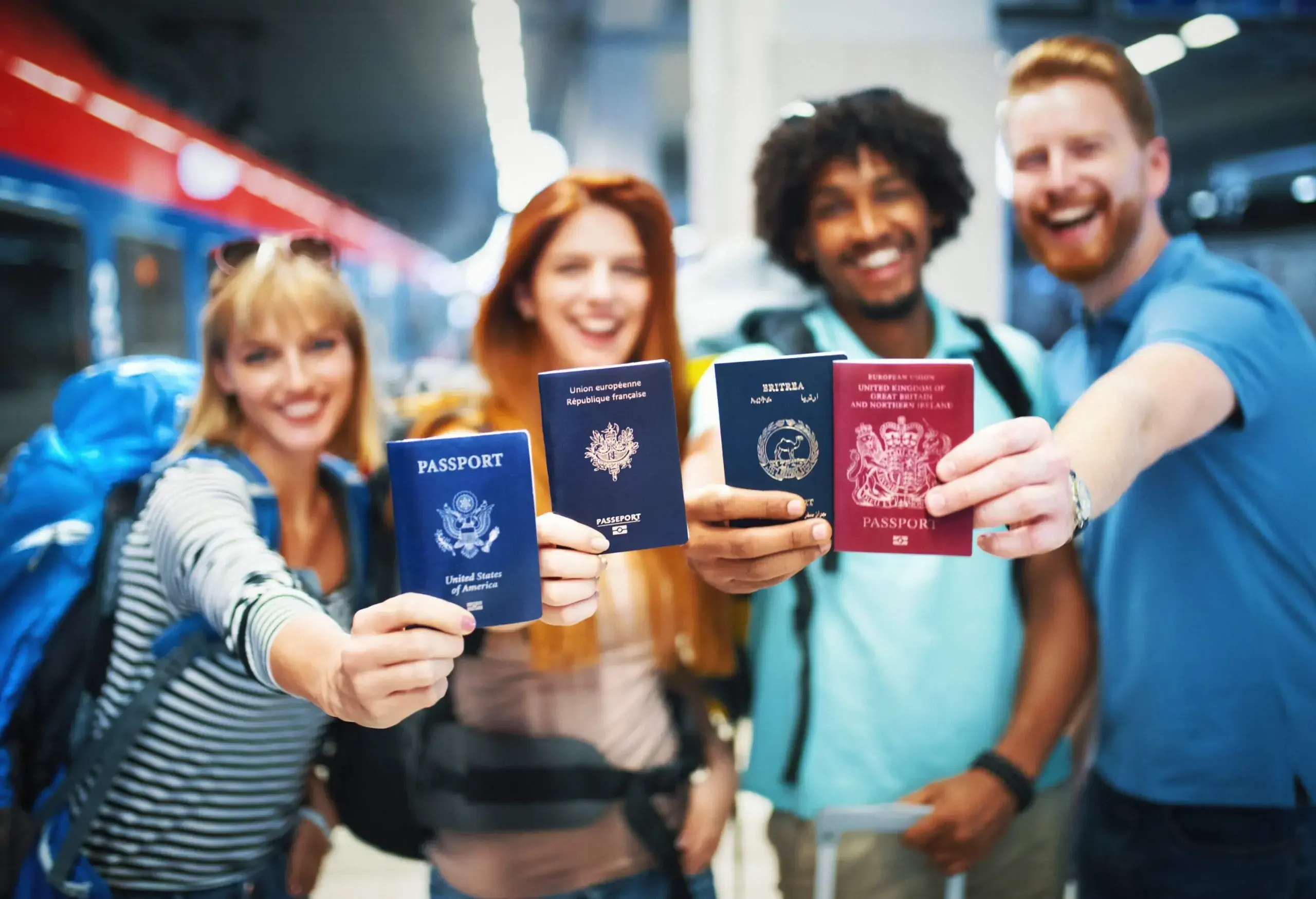
Each country is free to decide its own passport color, but the colors they choose often have economic, cultural, political, or even religious significance. So what do the different colors mean? And can there be different colors within one country? To answer these questions, let’s explore passport colors by country.
What are the different passport colors and their meanings?
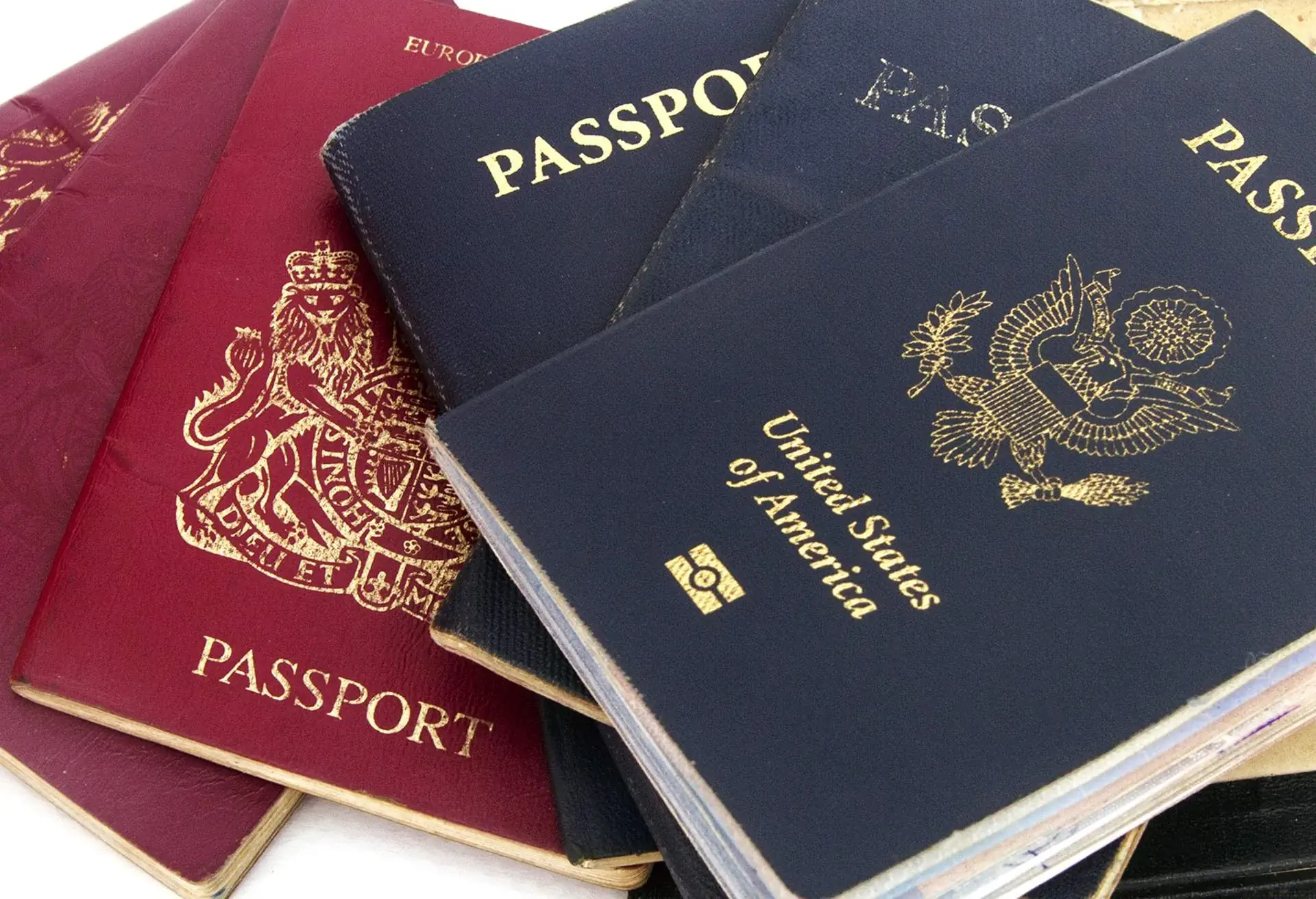
There are four different passport colors: blue, red/burgundy, green, and black. But what do they mean? Let’s cover each one in detail.
Blue
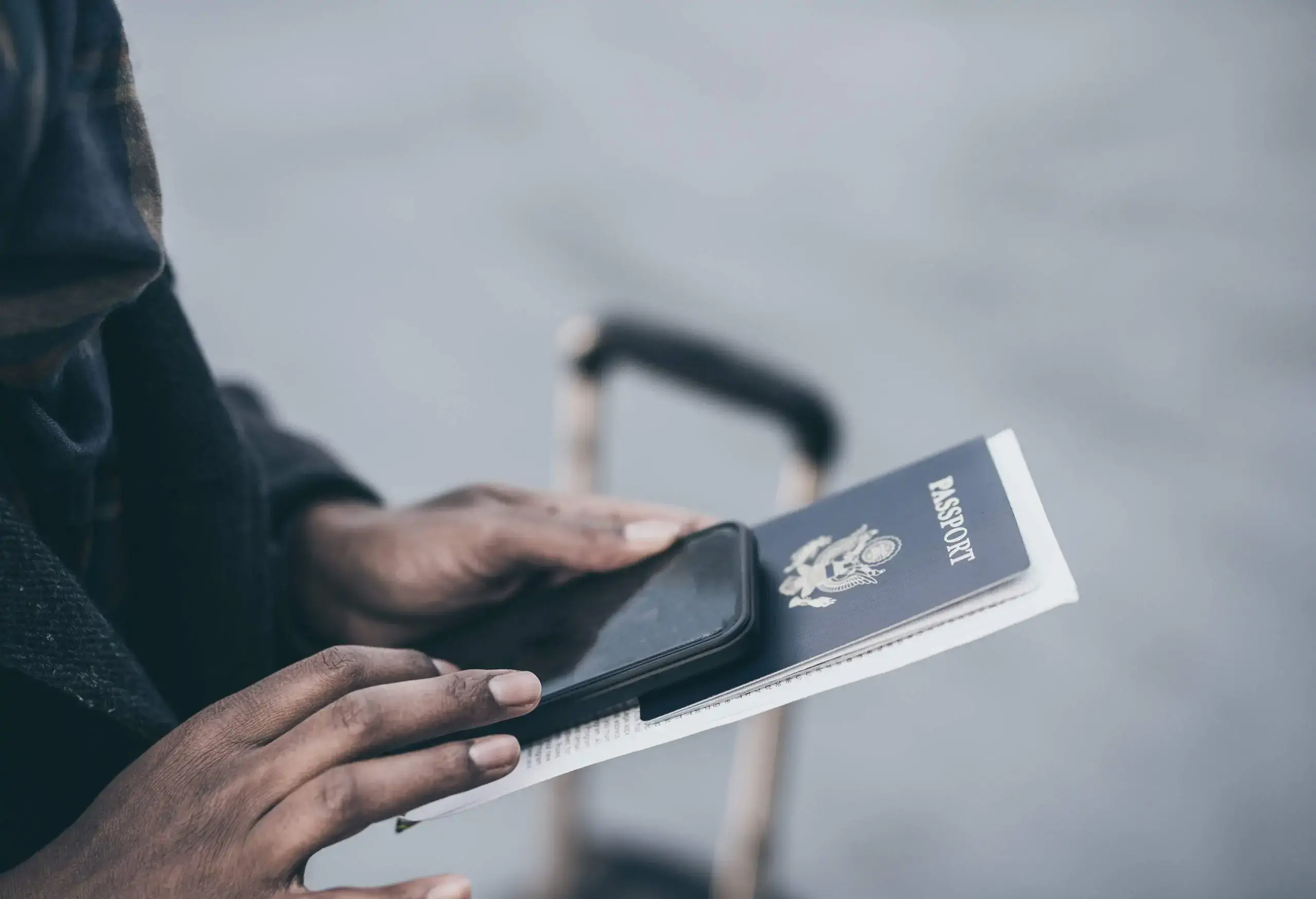
US citizens have blue passports, along with citizens of several other countries.
A blue passport typically represents the “new world” but it can also be an indication of the economic union that a specific country is a part of. Most of South America, the Caribbean countries, and U.S. territories have blue passports. Although, several countries that are not part of the “new world” have blue passports, such as a few in Africa and Asia.
Red
A red/burgundy passport is also typically an indication of the country’s economic union status. For example, all EU countries have burgundy passports, and the UK changed its passport from burgundy to blue when it withdrew from the EU.
Switzerland also has a red passport, which matches their flag, and Türkiye, an EU hopeful, has switched to red.
Green
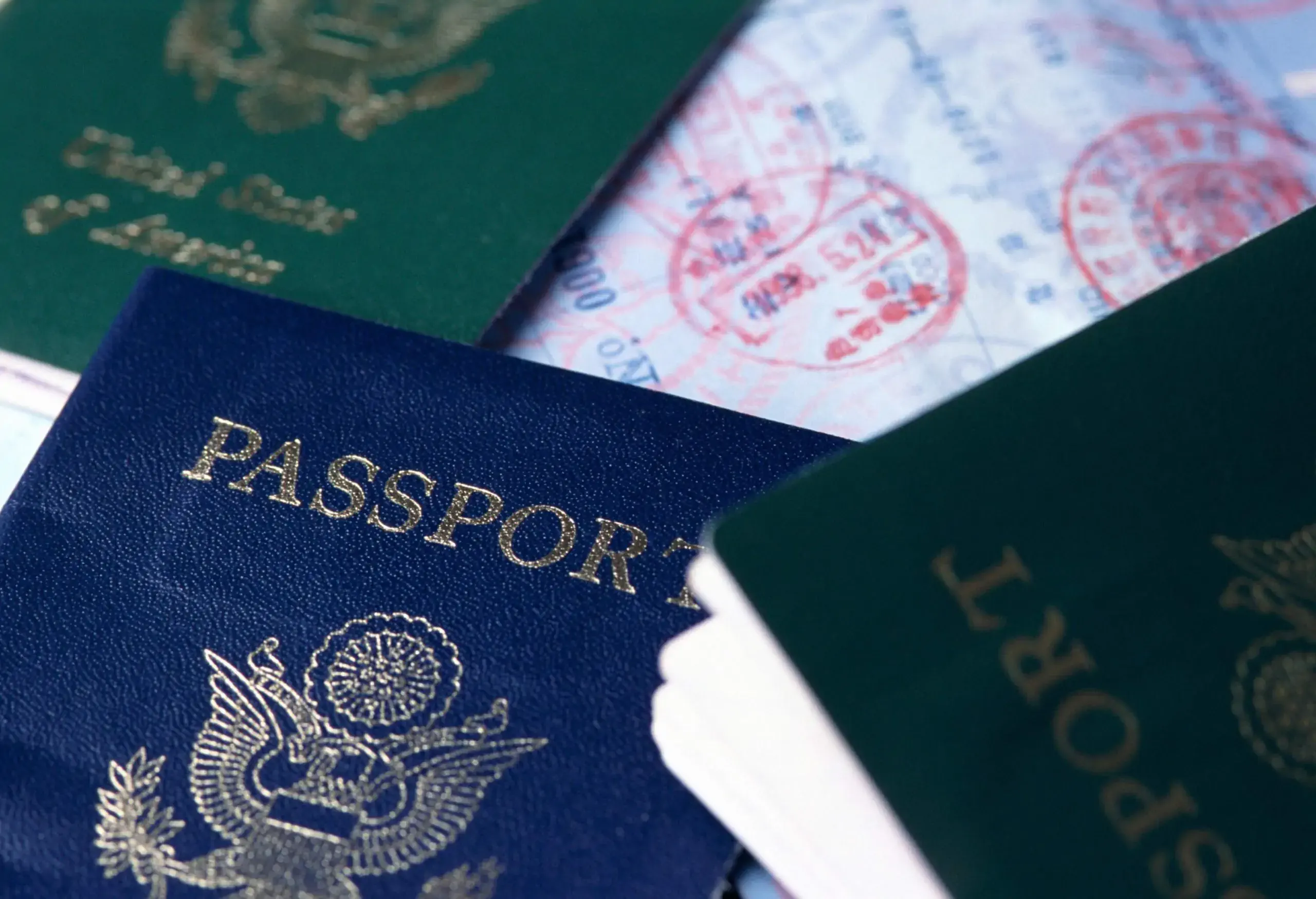
Green is an important color in the Islamic faith and is therefore used as the passport color for many Islamic countries. This includes places like Saudi Arabia, Egypt, Pakistan, and Morocco, as well as many African countries.
Mexico, Vatican City, and Taiwan also use green passports for non-religious reasons.
Black
This is the rarest passport color. Seen as the most practical color, it provides a nice contrast with the countries’ crests and also hides dirt well.
Countries using black passports include Angola, Malawi, Congo, The Palestinian Territories, Trinidad & Tobago, and Tajikistan. New Zealand also uses a black passport, as black is their national color.
How many passports for each color?
BLUE
84 passports, including Afghanistan, Honduras, Australia, Iceland, Laos…
RED
68 passports, including Albania, Bolivia, France, Cambodia, Philippines, Qatar…
GREEN
40 passports, including Algeria, Vatican City, Saudi Arabia, Burkina Faso, Mali…
BLACK
7 passports, including New Zealand, Trinidad and Tobago, Angola, Congo…
Why are there different U.S. passport colors?
There can even be different colors of passports within one country. U.S. passport colors can be black, maroon, gray, or blue. Most U.S. citizens have blue passports, while the other colors are issued to government employees. So what do these special U.S. passport colors represent?
The diplomat: Black U.S. passport
Diplomatic (black) passports are issued to U.S. government employees with diplomatic status, including foreign service officers, persons granted diplomatic titles, and certain high-level personal representatives of the President or Secretary of State.
These passports include specific endorsements for heads of state (the President, Vice President, former Presidents and Vice Presidents) and their authorized family members when traveling on official business.
The Maroon U.S. passport
Official (maroon) passports are issued to U.S. government officers and employees, along with eligible family members, when traveling on official government business.
This includes federal employees such as law enforcement agents when authorized, as well as active-duty members of the military traveling on certain official orders (though military personnel may also use military ID and travel orders where a Status of Forces Agreement applies).
The Gray U.S. passport
Service (gray) passports are issued in limited circumstances to non-personal services contractors and other narrowly defined categories who must travel in support of the U.S. government when a regular passport is not sufficient. Use and issuance are restricted and authorized by the Department of State.
The classic: Blue U.S. passport
Regular U.S. citizens have blue passports. To be clear, people who have other U.S. passport colors also have blue passports, as the other colors are not valid for leisure travel.
There’s also a no-fee version of the blue passport provided to members of the American Red Cross, the Peace Corps, and the Department of Defense.
It’s important to note that special-issuance passports (diplomatic, official, service) are explicitly limited to official or diplomatic travel and are not valid for personal or leisure travel. Individuals who need to travel for personal reasons must use a regular passport, which means government personnel either hold or must obtain a regular passport (fee or no-fee) for personal trips.
The main difference between the regular passports and all special-issue passports is that the special-issue passports don’t require a fee and are only valid for five years.
The evolution of the U.S. Passport
1920
Green The League of Nations standardized passport requirements, and the U.S. followed suit. The U.S. passport evolved into a small green booklet.
1970
Blue The passport became patriotically blue to celebrate the U.S. Bicentennial.
1993
Green In 1993, the green cover returned to celebrate the bicentennial of the U.S. Consular Service. This, however, was a short-lived change.
1994
Blue In 1994, the passport color was changed back to blue and has remained so ever since. It is believed that this blue matches that of the American flag.
What will passports look like in the future?
The evolution of the passport is ongoing and will change as the world itself continues to change. As we move further into the digital age, we may find that passports in the future could also be digitized. Our physical passports already carry biometric information, and it remains to be seen how the development of new technology will affect passports in the future.
No, passport color has no effect on visa-free access or a passport’s “power.” Those privileges depend entirely on the passport holder’s nationality and bilateral or multilateral agreements between countries, not the cover color.
No, there’s no global standard for passport cover color. Each country chooses its own, though regional and cultural patterns exist (for example, many EU countries use burgundy and many Islamic-majority countries use green).
Yes, many countries issue different-colored covers to distinguish ordinary, diplomatic, and official/service passports. The U.S. is one clear example, but many other governments do the same. Always check your government’s passport office page to confirm what each color represents.
Brittany MuldoonOriginally from Cincinnati, OH, Brittany has been living and working in Prague, CZ, for the past 7 years. Convinced that travel and music are the best forms of connection, she strives to use her creative skills to share these passions with the world. In her free time, she’s probably drinking a cold brew and planning her next adventure.
Want to know the world better? We got you covered.
Sign up for our newsletter and get more travel inspiration straight to your inbox each week
We value your privacy
California consumers have the right to opt out of the sale* of their personal information. For more information on how we securely process personal information, please see our Privacy Policy.
Do not sell my info
* The definition of "sale" under the California Consumer Privacy Act is applicable only to California consumers.