
A carry-on can help you skip baggage claim and avoid checked bag mishaps. This guide covers airline size and weight limits, personal item rules and what to expect before you fly.
- Most US airlines allow a carry-on up to 22 x 14 x 9 inches, including wheels and handles.
- Carry-on weight limits vary by airline.
- A personal item must typically fit under the seat in front of you.
In this article
What is the standard carry-on luggage size?
Most US airlines allow carry-on bags up to 22 x 14 x 9 inches, including wheels and handles.
While this is the standard for most domestic flights, carry-on size limits can vary by airline, route and fare type. International airlines often use slightly different dimensions, but most allow carry-on bags that are roughly the same size as the US standard. A common international limit is 21.5 x 15.5 x 9 inches or 46 linear inches.
Some airlines though have stricter rules. Qatar Airways, for example, allows carry-on bags up to 20 x 15 x 10 inches (45 linear inches). If you’re flying with a smaller regional airline or a budget carrier in Europe, it’s worth paying extra attention to the baggage policy, as restrictions can vary significantly.
While carry-on dimensions are usually listed as height, width and depth, one thing that’s worth knowing is that a handful of airlines, including Delta, American Airlines, Air Canada and Southwest Airlines, use linear inches instead. Rather than checking each dimension separately, they add together your bag’s height, width and depth to get a single measurement.
A few airlines, including Delta, American Airlines, Air Canada and Southwest Airlines, measure their carry-on using linear inches. This is a measurement that adds up the height, width and depth of your carry-on to create a single total number.
For example, Delta’s carry-on limit is 45 linear inches:

45 linear inches (allowed) 22 (h) + 14 (w) + 9 (d) = 45 inches
25 (h) + 10 (w) + 10 (d) = 45 inches
46 linear inches (too large)

24 (h) + 14 (w) + 8 (d) = 46 inches
Carry-on size limits are there to make sure everyone’s luggage will fit in the overhead bins. I always try to fly with only carry-on luggage no matter where I go or for how long. Apart from it forcing me to not overpack, I always travel easier knowing my luggage is in reach rather than in the hold, or even worse, still back at the airport!
What are carry-on luggage weight limits?
Carry-on weight limits tend to vary much more than size restrictions. While most airlines clearly publish their carry-on dimensions, weight allowances can differ significantly.
Many major US airlines, including Delta, JetBlue and United Airlines, don’t publish a carry-on weight limit. In most cases, if your bag meets the size requirements and you can lift it into the overhead bin yourself, you’re good to go.
Where weight limits do apply, they can vary widely by airline and sometimes even by route. At the stricter end of the scale, airlines including Qantas, Qatar Airways and Singapore Airlines allow carry-ons weighing up to 15 lbs. British Airways is among the most generous, with a carry-on allowance of up to 51 lbs.
If your airline has a carry-on weight limit, it’s best to stay within it. While enforcement varies, some airlines routinely weigh bags at check-in or the gate.
What counts as a personal item on a plane?
A personal item is a small bag that fits under the seat in front of you, such as a backpack, purse, laptop bag or briefcase. Most airlines allow one personal item in addition to your carry-on bag, although size limits vary by carrier.
Many airlines publish specific personal item dimensions, typically around 18 x 14 x 8 inches. Others, including Alaska Airlines, Delta and Southwest Airlines, don’t specify exact measurements and simply require the item to fit under the seat in front of you.
Some airlines also allow additional essential items, such as diaper bags, medical devices and mobility aids. If you’re traveling with something that falls outside the standard allowance, it’s worth checking your airline’s policy before you fly.
Personal item size limits by airline.
The table below compares personal item size limits across major US airlines. Where no dimensions are listed, the airline uses a fit-under-the-seat standard rather than specific measurement.
| Airline | Personal item size | Personal item weight limit |
|---|---|---|
| Alaska Airlines | not specified | not specified |
| Allegiant Air | 18 x 14 x 8 in | not specified |
| American Airlines | 18 x 14 x 8 in | not specified |
| Delta | not specified | not specified |
| Frontier | 18 x 14 x 8 in | not specified |
| Hawaiian Airlines | must fit under seat in front of you | not specified |
| JetBlue | 17 x 13 x 8 in | not specified |
| Southwest Airlines | not specified | not specified |
| United Airlines | 17 x 10 x 9 in | not specified |
Carry-on bag vs. a personal item: what’s the difference?
The practical difference between carry-on luggage and a personal item is that the former is for storage in the overhead bin and the latter for under the seat in front of you. A personal item is always free to take on board.
Many airlines also include a carry-on luggage allowance in the ticket price. Some – especially small and budget airlines – charge extra, although it’s usually still cheaper than paying for checked luggage.
Carry-on size and weight limits for US airlines.
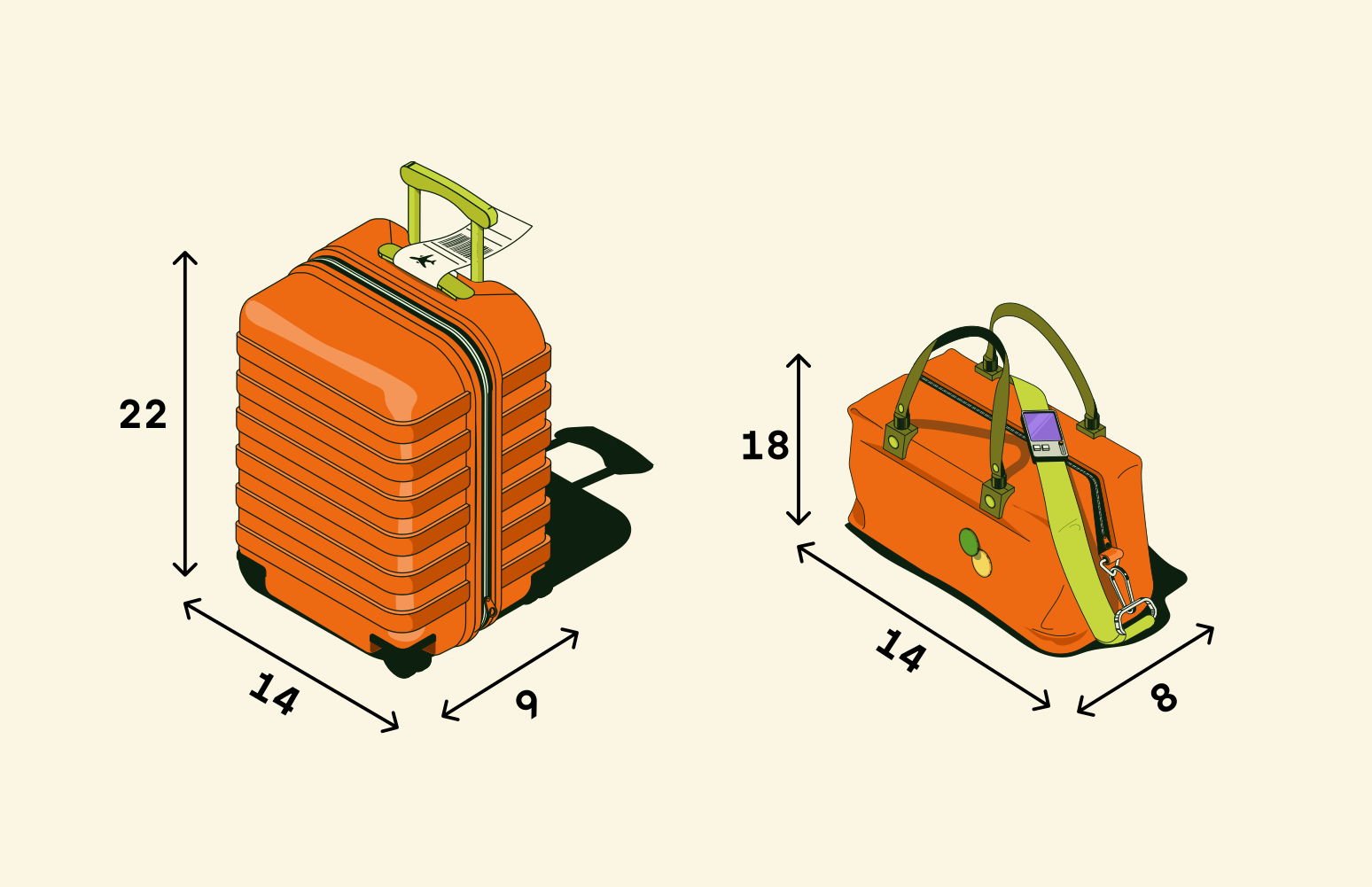
Most US airlines allow carry-on bags up to 22 x 14 x 9 inches, including wheels and handles. While this has become the standard across much of the industry, carry-on size limits can vary by airline.
A few carriers are more generous. Frontier and Southwest Airlines, for example, allow slightly larger carry-on bags than the standard US limit.
Weight restrictions are much less common. Most major US airlines, including Delta, JetBlue and United Airlines, don’t publish a carry-on weight limit and instead focus on bag dimensions.
Hawaiian Airlines and Frontier Airlines are among the few domestic carriers that impose carry-on weight restrictions.
The table below compares carry-on size and weight limits across major US airlines, making it easy to find the rules for your specific carrier before you fly.
| Airline | Carry-on bag size | Carry-on weight limit |
|---|---|---|
| Alaska Airlines | 22 x 14 x 9 in | not specified |
| Allegiant Air | 22 x 16 x 10 in | not specified |
| American Airlines | 22 x 14 x 9 in | not specified |
| Delta | 22 x 14 x 9 in | not specified |
| Frontier | 25 x 16 x 10 in | 35 lbs |
| Hawaiian Airlines | 22 x 14 x 9 in | 25 lbs |
| JetBlue | 22 x 14 x 9 in | not specified |
| Southwest Airlines | 24 x 16 x 10 in | not specified |
| United Airlines | 22 x 14 x 9 in | not specified |
Looking for airline-specific carry-on rules?
Carry-on size and weight limits can vary by airline, fare type and route. If you’re flying with a specific carrier, check our detailed airline guides linked in our table before you pack.
Carry-on size and weight limits for international airlines.
International airlines tend to be stricter about carry-on luggage than most US carriers. While carry-on size limits are often similar, weight restrictions are far more common and are usually enforced.
Most international airlines list their baggage dimensions in centimeters. We’ve converted them to inches in the table below to make comparing airlines a little easier.
You’ll notice that many major carriers, including Aer Lingus, Air Canada, Lufthansa, SAS and Turkish Airlines, allow carry-on bags of a similar size. Others are less generous. Qatar Airways, for example, has one of the smaller carry-on allowances among major international airlines.
Heads up: international airlines are often stricter
Most US airlines rarely weigh carry-on bags, and enforcement tends to focus on size. Many European and Asian carriers take a stricter approach, routinely checking both dimensions and weight at the gate. If your bag exceeds the limit, you could face additional fees or be required to check it before boarding.
If you’re flying with airlines such as Ryanair or easyJet, treat the limits in the table below as firm rules rather than rough guidelines.
| Airline | Carry-on bag size | Carry-on weight limit |
|---|---|---|
| Aer Lingus | 21.7 x 15.7 x 9.4 in | varies by route |
| Air Canada | 21.7 x 15.7 x 9 in | not specified |
| Air France | 21.7 x 13.8 x 9.8 in | varies by cabin class |
| British Airways | 22 x 17.7 x 9.8 in | 51 lbs |
| easyJet | 22 x 17.7 x 9.8 in | 33 lbs |
| Emirates | 21.7 x 15 x 8.7 in | 15 lbs |
| Icelandair | 21.7 x 15.7 x 7.9 in | varies by route |
| KLM | 21.7 x 13.8 x 9.8 in | 26.4 lbs* |
| Lufthansa | 21.7 x 15.7 x 9 in | 17 lbs |
| Qatar Airways | 19.7 x 14.6 x 9.8 in | 15 lbs |
| Ryanair | 21.7 x 15.7 x 7.9 in | 22 lb |
| SAS | 21.7 x 15.7 x 9 in | 17.6 lb |
| Turkish Airlines | 21.7 x 15.7 x 9 in | 17.6 lbs |
| Volaris | 22 x 16 x 10 in | varies by fare type |
| Vueling | 21.7 x 15.7 x 7.9 in | 22 lbs |
*Combined weight of carry-on bag and personal item.
Carry-on sizer boxes: What happens if your bag doesn’t fit?
A sizer box is a metal or plastic frame at the gate, or increasingly, pre-security, that represents the maximum carry-on dimensions an airline allows.
- Airlines that commonly use sizer boxes include Ryanair, easyJet, Spirit and an increasing number of US carriers.
- Your bag must fit without forcing it, with wheels, handles, and all protrusions included.
- What happens if it fails: some airlines offer a free gate check; others charge gate fees of up to $100.
Do airlines actually measure carry-on bags? At most US airlines, enforcement is visual and inconsistent, agents rarely pull out a measuring tape. European and budget carriers are far stricter, actively using sizer boxes and charging gate fees for non-compliance.
Carry-on liquid rules.
Liquids are one of the easiest ways to get held up at security. To avoid surprises, keep liquids, gels and aerosols in containers of 3.4 oz (100 ml) or less, packed inside one clear quart-sized bag.
Need to travel with medication, breast milk or other exceptions? Check out KAYAK’s complete guide to traveling with liquids.
What’s new for carry-on rules in 2026?
Short answer: not much. No new global standard carry-on size has been introduced for 2026, despite viral social media posts and videos claiming otherwise. Existing airline size limits remain unchanged.
What is increasing is enforcement: more airlines are deploying physical sizer boxes at gates and, in some cases, pre-security checkpoints, to catch oversized bags before boarding. The FAA has not mandated any new carry-on dimensions.
Always check your specific airline’s official baggage policy before you fly.
Carry-on bag rules in the EU.
The European Union has been reviewing airline baggage fees and whether standard carry-on bags should be included in the price of a ticket. Rules and enforcement continue to evolve, however, and carry-on allowances still vary by airline and fare type.
If you’re flying within Europe, check what’s included before you book. Some fares include both a carry-on bag and a personal item, while others may only include a smaller item that fits under the seat in front of you.
New power bank rules on some airlines.
Several airlines have introduced stricter rules for carrying and using power banks onboard due to concerns about lithium battery fires.
Power banks should never be packed in checked luggage and must be carried in the cabin. Some airlines now require passengers to keep power banks on their person rather than in the overhead bin, while others have introduced restrictions on charging or using them during the flight.
Because policies vary by airline, it’s worth checking the latest rules before you travel, especially if you’re flying with carriers in Asia, where a number of airlines have recently updated their guidance.
Carry-on luggage FAQs.
A backpack is generally considered a personal item rather than a carry-on, as long as it fits below the seat in front of you or meets the dimensions specified by the airline.
If you’re traveling with a full size backpack that can only be stored in the overhead bins, this would qualify as carry-on luggage. As always, check the permitted dimensions and weight before you travel.
A duffel bag is typically considered carry-on luggage, yes. This does, of course, depend on its dimensions which are almost always the deciding factor for airlines over the type of luggage you have.
If it’s too big to fit under the seat in front of you and has to go in the overhead bin, you should consider it to be carry-on luggage rather than a personal item.
None of the international airlines we’ve mentioned in this guide would allow a 24-inch suitcase as carry-on, as it doesn’t meet their size requirements. Domestically, Southwest Airlines would allow you to take your 24-inch suitcase as carry-on thanks to theirits generous size limits.
Generally, I’d say a 24-inch bag will be treated as checked luggage more often than carry-on, so think carefully before traveling with it!
Disclaimer: Prices and information are correct as of 25.06.2026 and may vary with time.